Abbeville County VINELink Coverage
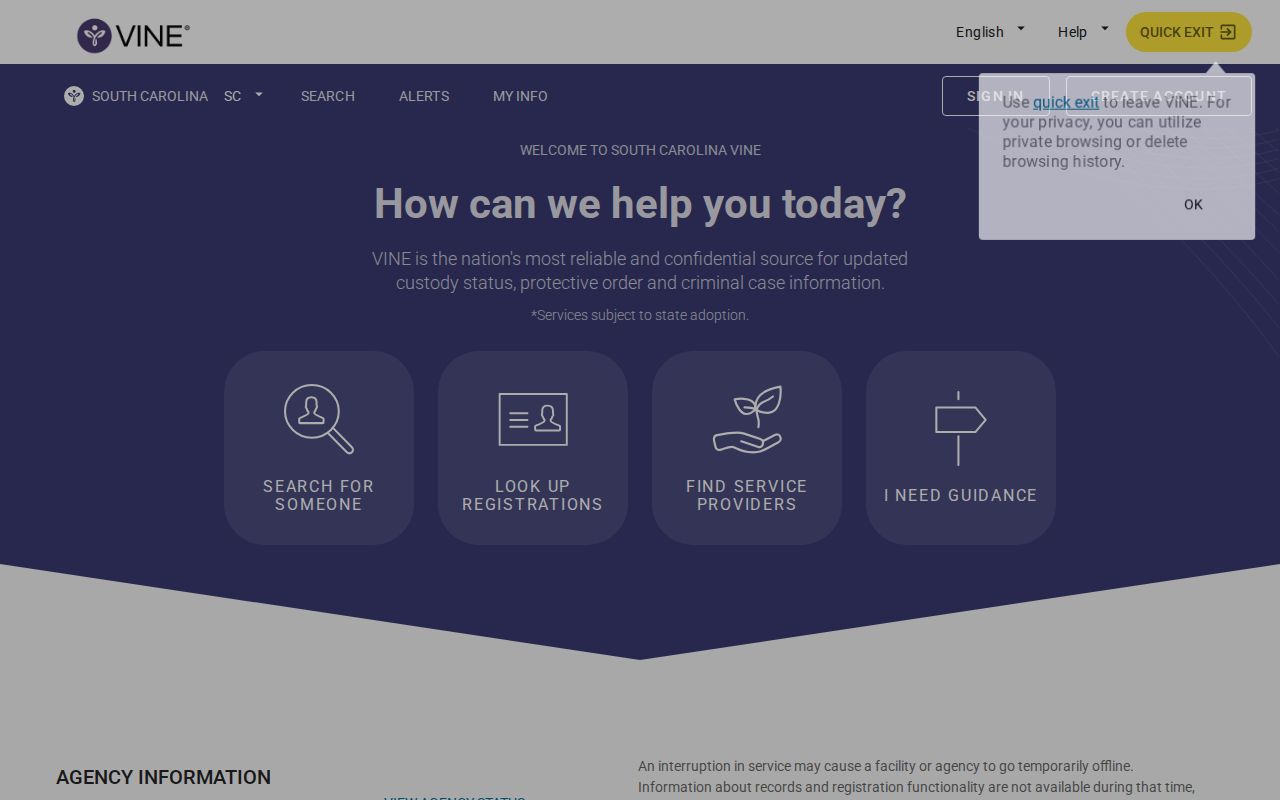
South Carolina calls the service SC VINE, short for Victim Information and Notification Everyday. Its official material says the system receives information from county detention centers, the South Carolina Department of Corrections, and the South Carolina Department of Probation, Parole and Pardon Services. Abbeville County Detention Center is listed as a participating facility. Access is available through South Carolina VINELink, through mobile access, or by telephone at 1-866-727-2846.
The agency name on the result controls its meaning. A county-detention result concerns the Abbeville jail record. An SCDC result concerns state prison custody. An SCDPPPS entry concerns supervision in the community, not incarceration. These records cannot be treated as one continuous roster. If a person left the county jail for SCDC, the county event may be a transfer rather than a community release. Search the receiving system and confirm the handoff.
Search Abbeville County VINELink Records
Begin with the last known custodian and the best identifiers available. A common name alone can produce the wrong match. Compare any displayed age, identification number, agency, and event details. The broader Abbeville County released inmate search explains how to combine jail, court, state, and federal sources when VINE alone does not settle the question.
- Open South Carolina in VINELink and choose the relevant person or custody search.
- Enter the exact name or identifier shown by the booking or corrections record.
- Use available age, date, or agency details to narrow similar names.
- Open the individual record and note the status, reporting agency, and displayed event date.
- If a transfer is possible, repeat the check with the receiving jail, SCDC, or other authority.
- Call the reporting agency when an exact same-day or certified answer is needed.
For a person last held at Abbeville County Detention Center, the direct fallback is 864-446-6200. Ask whether the person is physically present, was released to the community, or was transferred. For a state prisoner, use the SCDC current-inmate tool and the separate Released Inmate Search. A no-result in the current tool does not prove release because that search expressly excludes released people and community supervision.
Abbeville VINELink Release Fields
VINELink presents the fields supplied for the specific record. Availability varies, so an empty field should not be filled by assumption. Save the check time and read the exact administrative wording. A status label can describe an event without explaining every court order or hold behind it.
| Field | What it establishes |
|---|---|
| Name and identifiers | Help distinguish the selected person from similar names. |
| Reporting agency | Shows whether the record comes from county detention, SCDC, or SCDPPPS. |
| Custody or supervision status | Reports the state last sent by that participating agency. |
| Facility or location | Identifies the supplying location when that field is public. |
| Event and date | May record release, transfer, or another covered status change. |
| Notification options | Shows which alert methods and events are offered for that record. |
A reported release should be checked with its source. The detention center keeps the physical county-jail exit record. SCDC holds the state-prison release record. SCDPPPS can verify active supervision. The court file may explain bond, dismissal, sentence, or another order, but it may not state the exact time the jail door opened.
Register Abbeville Release Notifications
A search does not automatically create an alert. Registration begins from the correctly matched record. The interface may offer telephone, text, email, or application notices based on the record and current service options. Select only after checking the source agency and identity.
- Choose the notification or “Get Notified” control on the matched record.
- Select the available contact method and enter the destination accurately.
- Choose the offered release, transfer, or custody-change events.
- Create the four-digit PIN used for telephone notices.
- Complete any code, link, or other confirmation step.
- Save the registration confirmation and keep the PIN private.
The SC VINE FAQ says telephone calls continue for up to 48 hours or until the four-digit PIN is entered. Entering the PIN confirms receipt and stops repeat calls. The PIN is not an inmate number. It should not be posted or shared. If a phone number or email address changes, review the registration instead of assuming the old destination will still work.
Note: Registration confirms an alert request, not a person's release, legal status, or the time an agency will enter an event.
Abbeville Release Alert Timing
SC VINE says it collects participating booking and offender-system data every 15 minutes. That is a collection schedule, not a promise of instant entry or delivery. Staff must first record an event in the source system. A transmission or contact method can then lag or fail. Note the time of the VINE check, and do not convert the cadence into a claimed release time.
A same-day answer needs a second step. Call Abbeville County Detention Center for a county event. Contact SCDC for a prison event, or the Abbeville SCDPPPS office for a supervision question. If the result says transfer or the person disappears, identify the receiving authority. Absence may also reflect spelling, protected data, timing, or a record outside VINE's scope.
Victim Alerts After Abbeville Transfer
Formal notification for a crime victim involving an SCDC offender has a separate South Carolina path. SC VINE directs that registration to SCDC Victim Services at 1-800-835-0304. This distinction matters when an Abbeville County detainee is sentenced and transferred into state custody. A county registration should not be assumed to follow the person into SCDC automatically.
Confirm the new custodian, then register through the channel that covers it. The VINE record can help identify the source agency. SCDC Victim Services can address the state-prison notification route and also offers a telephone service for current location and projected-date checks by SCDC number, SID, or name. Keep each confirmation because a later transfer can change the responsible source again.
Notification registration should follow the custody record. A person may first appear under Abbeville County Detention Center, later under SCDC, and then under SCDPPPS after prison release. Those changes describe separate agencies and events. Save each confirmation and review the offered event types at every stage. An alert tied to one record may not cover a later supervision event.
If the person remains at the county detention center, the local result and 864-446-6200 are the right same-day pair. Once SCDC becomes the custodian, the state current-inmate search and Victim Services provide the better cross-check. After an SCDC release, read the exact release type in the separate Released Inmate Search and consult SCDPPPS when the result points to community supervision.
VINE notification is free, but it is not a certified record service. A saved alert can document what notice arrived and when. The official jail release sheet, SCDC release record, or supervision record remains the stronger source for the event itself.
Abbeville VINELink Scope Limits
VINELink does not replace the source record. It does not cover federal Bureau of Prisons custody. For a federal sentence, use the BOP Inmate Locator, whose historical records may show a release date and “Released” or “Not in BOP Custody.” Those terms end only BOP custody and do not resolve a state hold, immigration custody, or federal supervised release.
ICE uses its own Online Detainee Locator. The SLED Sex Offender Registry is also separate and applies only when registration law requires it. A registry record is not a general list of released people and does not prove when someone left the Abbeville jail. If VINELink is silent, classify the custody type, use the correct official locator, and request the underlying release record when documentary proof matters.
The sound verification chain is simple: identify the last custodian, read the reported event, check for a receiving authority, and contact the agency that owns the record. That prevents a delayed alert, no-result, or transfer from being mislabeled as a confirmed community release.